Don't take your indoor air for granted. In our experience manufacturing air filters for over a decade and serving more than two million households, one pattern shows up again and again: the furnace is almost always dirtier than the homeowner expects — and the air quality is almost always worse than they know. Dust, dander, mold spores, and debris don't just sit inside your furnace. Every time your system runs, they circulate through your home silently and invisibly.
What separates how to clean a furnace for better air quality and stronger system performance comes down to which components get addressed and how completely. That's the insight most guides skip, and exactly what this page covers.
TL;DR Quick Answers
How to Clean a Furnace
Cleaning a furnace correctly means addressing the components that directly affect your air quality and system safety — not just the surfaces you can see. After manufacturing air filters for over a decade and serving more than two million households, here is what a complete furnace cleaning covers:
Turn off power and gas before opening any access panels
Replace the air filter with one rated appropriately for your system
Clean the blower wheel and blower compartment to restore proper airflow
Clean the burner assembly to ensure complete combustion and reduce byproduct risk
Inspect the heat exchanger for cracks or buildup that allow combustion gases into circulated air
Check and clean the flue and venting system to confirm combustion gases are safely exhausted
Vacuum the furnace interior including the burner compartment and surrounding components
Schedule professional service annually — ideally in late summer or early fall before peak heating season begins
Basic tasks like filter replacement and exterior vacuuming are manageable for most homeowners. The blower assembly, heat exchanger, and burner components require a licensed HVAC professional. A clean furnace runs more efficiently, lasts longer, and delivers measurably cleaner air — making annual cleaning one of the highest-value maintenance decisions a homeowner can make.
Top Takeaways
A dirty furnace is an active air quality threat. Every heating cycle pushes dust, debris, mold spores, and combustion byproducts into the air your family breathes. Cleaning removes the source — not just the symptom.
Filter changes alone are not enough. A high-quality filter on a dirty furnace cannot win the battle on its own. The blower wheel, burner assembly, and heat exchanger need attention too. Both the filter and the system require regular maintenance.
Timing matters as much as the cleaning itself. 36% of annual CO poisoning deaths occur in December, January, and February — peak furnace months. Schedule professional cleaning before the heating season. It is the single most effective intervention a homeowner can make.
The benefits of a clean furnace are invisible until they aren't. Fewer winter headaches. Less dust between cleanings. More stable energy bills. Most homeowners only make the connection after the cleaning — which is exactly why annual maintenance needs to be a standing commitment, not a reactive one.
How a Dirty Furnace Affects the Air You Breathe
Your furnace does more than heat your home — it constantly moves air through it. When the heat exchanger, blower compartment, and burner assembly accumulate dust and debris, that contamination travels through your ductwork with every heating cycle. What starts as a mechanical problem quickly becomes an air quality problem.
In our experience, the homes with the most persistent air quality complaints often have one thing in common: a furnace that hasn't been properly cleaned in years. Symptoms homeowners attribute to seasonal allergies or poor ventilation frequently trace back to a neglected heating system.
Which Furnace Components Have the Biggest Impact on Air Quality
Not all furnace cleaning tasks contribute equally to cleaner air. The components with the most direct influence are:
The blower and blower compartment. The blower fan circulates all the air in your home. Dust buildup on the blower wheel reduces airflow efficiency and releases particulates into the air supply with every cycle.
The burner assembly. Dirty burners produce incomplete combustion, which can introduce carbon monoxide and other combustion byproducts into your living space.
The heat exchanger. Cracks or buildup on the heat exchanger are among the most serious air quality risks a furnace can present. Even small cracks allow combustion gases to mix directly with circulated air.
The air filter housing and filter. A clogged or improperly seated filter bypasses its own function, allowing unfiltered air to move freely through the system.
Why Filter Replacement Alone Isn't Enough
Changing your air filter regularly is essential — but it only addresses what the filter can capture. It does nothing for buildup that has already accumulated on internal components upstream of the filter. After manufacturing air filters for over a decade, we are clear about what filters can and cannot do. A high-MERV filter on a dirty furnace is like a clean front door on a house full of dust. The filter protects the system from new debris, but it cannot clean what's already inside.
How Often Furnace Cleaning Actually Improves Air Quality
Annual professional furnace cleaning is the standard recommendation — and for most households, it's the right baseline. But certain conditions call for more frequent attention:
Homes with pets, which accelerate debris accumulation inside the system
Households with allergy or asthma sufferers, where particulate levels have a greater health impact
Older homes with deteriorating ductwork, where debris enters the system from multiple points
Homes that went through renovation or construction, which dramatically increases airborne particulate load
What a Quality Furnace Cleaning Should Include
A furnace cleaning that genuinely improves indoor air quality goes well beyond a visual inspection. It should include a thorough cleaning of the blower assembly, burner and burner compartment, heat exchanger inspection, flue and venting check, and a filter replacement with a properly rated filter for the system. Anything less addresses the appearance of maintenance without the substance of it.
The Connection Between Furnace Condition and Long-Term Air Quality
Serving over two million households has shown us that indoor air quality is rarely the result of a single factor. It's cumulative. A clean furnace paired with regular filter changes, high-quality furnace filters, properly sealed ductwork, and appropriate ventilation creates conditions where the air inside your home consistently performs better. Each element reinforces the others. Furnace cleaning is not a one-time fix — it is a foundational part of a home air quality system that compounds its benefits over time.
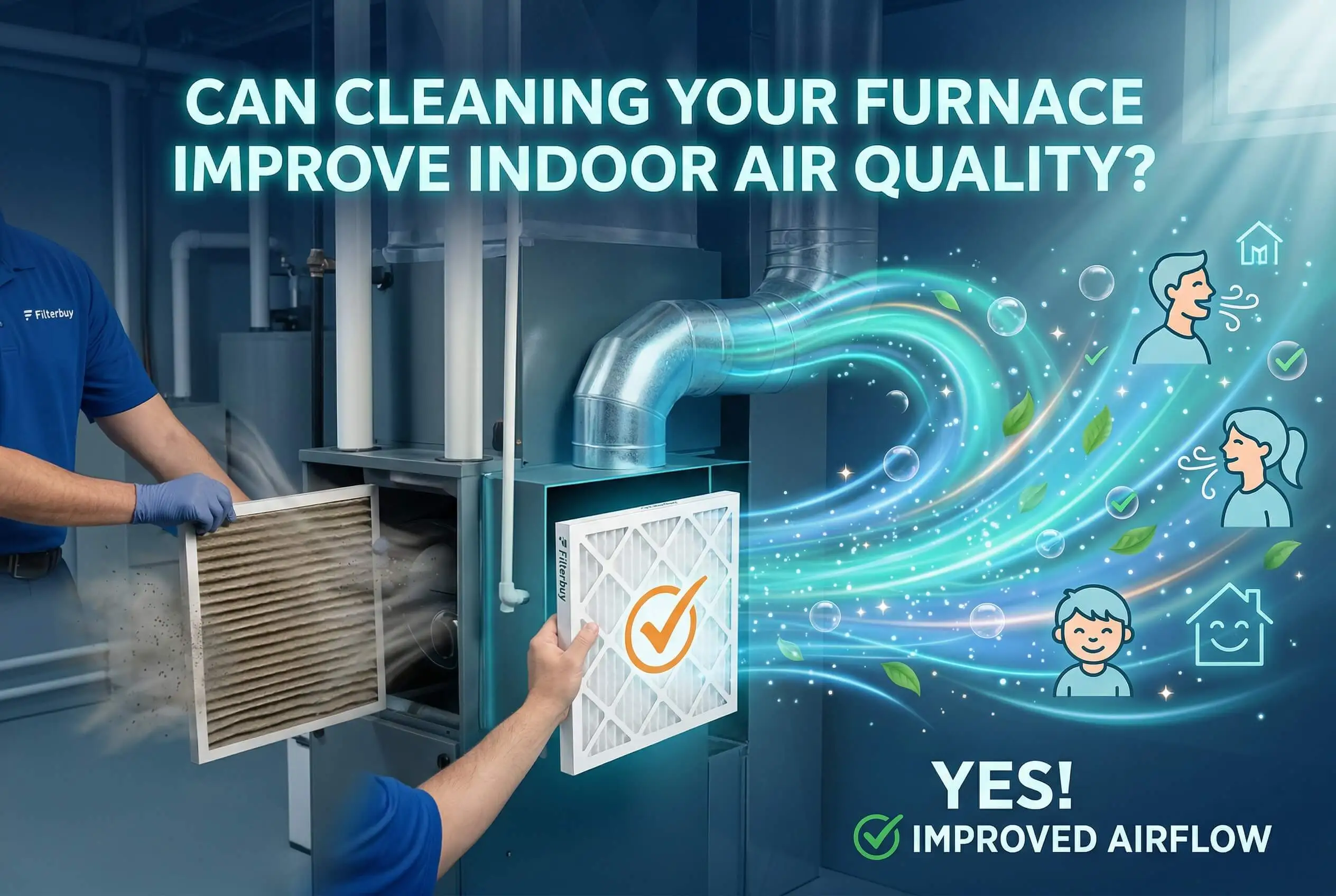
"Most homeowners are surprised to learn that their furnace is one of the most active contributors to poor indoor air quality — not just a passive bystander. After manufacturing air filters for over a decade and working with more than two million households, we've learned that indoor air quality problems rarely have a single cause, but a dirty furnace is almost always part of the picture. A high-quality filter on a neglected furnace is fighting an uphill battle it can't win on its own. Real improvement comes when the entire system is clean — because clean air starts with a clean source."
Essential Resources
1. Your Step-by-Step Guide to Cleaning Every Critical Furnace Component
Most cleaning guides cover the basics. This resource goes further — breaking down exactly which components to clean, in what order, and how thoroughly, so nothing that affects your air quality gets missed.
2. Why the Federal Government Recommends Annual Furnace Cleaning
The U.S. EPA identifies improperly maintained furnaces as a direct source of indoor carbon monoxide — and recommends professional inspection and cleaning every year without exception. This resource explains the federal position and why it exists.
epa.gov/indoor-air-quality-iaq/carbon-monoxides-impact-indoor-air-quality
3. How to Choose the Right Air Filter for a Freshly Cleaned Furnace
A clean furnace paired with the wrong filter leaves your air quality incomplete. The EPA's MERV rating guide explains how filter efficiency is measured and which rating levels are appropriate for residential systems.
epa.gov/indoor-air-quality-iaq/what-merv-rating
4. What the Research Actually Says About Furnace Filters and Indoor Air Quality
This EPA guide synthesizes research on how furnace and HVAC filters reduce indoor air pollutants, how to select the right filter for your specific system, and how filtration works alongside ventilation and source control.
epa.gov/indoor-air-quality-iaq/guide-air-cleaners-home
5. The Carbon Monoxide Risk Inside Every Gas and Oil Furnace
The CDC's furnace safety fact sheet is a direct, no-jargon public health reference covering the invisible risks that dirty or poorly maintained gas and oil-burning furnaces create — and the steps that prevent them.
cdc.gov/carbon-monoxide/factsheets/furnace-safety-fact-sheet.html
6. How a Dirty Heat Exchanger Puts Combustion Gases Into Your Air Supply
This EPA resource identifies cracked heat exchangers, blocked flues, and neglected furnace components as direct pathways for carbon monoxide and nitrogen dioxide to enter circulated indoor air — making it essential reading before any furnace cleaning.
epa.gov/indoor-air-quality-iaq/sources-combustion-products
7. How Filter Placement and MERV Selection Affect the Air Your Furnace Delivers
Filter efficiency alone does not determine air quality outcomes — placement, duct design, and system compatibility matter just as much. This U.S. Department of Energy reference covers how all three variables interact to determine what your furnace actually delivers into your home's air.
bsesc.energy.gov/energy-basics/hvac-proper-installation-filters
These essential resources show how furnace cleaning, filtration, and combustion safety support healthier indoor air, stronger system performance, and smarter maintenance decisions that can help extend system life and support better outcomes before any HVAC replacement is needed.
Supporting Statistics
The following statistics from U.S. government sources reinforce what we have observed firsthand after manufacturing air filters for over a decade and serving more than two million households — furnace maintenance is not optional upkeep. It is one of the most direct actions a homeowner can take to protect their family's health, safety, and household budget.
Americans spend approximately 90% of their time indoors — where concentrations of some pollutants are often 2 to 5 times higher than outdoor levels.
Most homeowners think about air quality as an outdoor problem. The EPA's data — and our own — tells a different story. Here is what that statistic means in practice:
Nine out of every ten hours, your family breathes recirculated indoor air
The system moving that air is your furnace
A dirty furnace does not filter that air — it contaminates it
The homes we hear from most about persistent dust and allergy flare-ups almost always share one thing: a furnace that hasn't been properly cleaned in years
Source: U.S. Environmental Protection Agency — Indoor Air Quality epa.gov/report-environment/indoor-air-quality
Unintentional carbon monoxide poisoning caused an average of 430 deaths per year in the United States between 1999 and 2010 — with gas and oil-burning furnaces among the primary contributing sources.
What makes this statistic striking is how preventable it is. A cracked heat exchanger or dirty burner does not fail suddenly. It deteriorates over time — usually in a furnace that hasn't been inspected in years. After working with millions of households, we know that deferred furnace maintenance rarely stays a minor issue. The warning signs to watch for:
Increased dust accumulation throughout the home
Unexplained headaches or flu-like symptoms during heating season
Yellow or flickering burner flames instead of steady blue
A furnace that hasn't been professionally cleaned in more than 12 months
Source: CDC Morbidity and Mortality Weekly Report — Unintentional Carbon Monoxide Poisoning Deaths, United States 1999–2010 cdc.gov/mmwr/preview/mmwrhtml/mm6303a6.htm
36% of all annual unintentional carbon monoxide poisoning deaths occur in December, January, and February — the months when residential furnaces operate most heavily.
The spike in CO-related deaths during peak heating months is not random. It is a direct consequence of systems pushed into heavy use without adequate preparation. In our experience, fall is the most critical window for furnace cleaning. Here is why timing matters:
Winter months trigger the heaviest, most continuous furnace operation of the year
Dirty heat exchangers and uncleaned burners deteriorate faster under sustained load
A system that runs for months without a pre-season cleaning is operating under exactly the conditions this CDC data describes
Scheduling furnace cleaning before the first cold snap is the single most effective timing decision a homeowner can make
Source: CDC Morbidity and Mortality Weekly Report — Unintentional Carbon Monoxide Poisoning Deaths by Month and Year, United States 2010–2015 cdc.gov/mmwr/volumes/66/wr/mm6608a9.htm
Heating and cooling buildings accounts for approximately 35% of all U.S. energy consumption — the largest share attributable to any single end use. A dirty or clogged furnace filter directly increases run time, motor wear, and energy consumption.
Homeowners often ask us whether furnace cleaning is worth the cost. This Department of Energy figure helps answer that question directly. What we have seen consistently across millions of households:
Annual furnace cleaning and timely filter changes correlate with more stable energy bills
Dirty systems work harder, run longer, and cost more to operate every single cycle
Fewer emergency service calls come from homes with maintained systems
A clean furnace performs closer to its rated efficiency — because it was designed to operate that way
Source: U.S. Department of Energy — Heating, Ventilation, Air Conditioning, Refrigeration, and Water Heating energy.gov/cmei/buildings/heating-ventilation-air-conditioning-refrigeration-and-water-heating
Final Thoughts
Cleaning your furnace improves your indoor air quality. But after manufacturing air filters for over a decade and working with more than two million households, our perspective goes further than the standard maintenance checklist.
Most homeowners are not dealing with an air quality problem. They are dealing with a system problem that expresses itself as an air quality problem. When the furnace is neglected, everything downstream suffers:
The air your family breathes
The efficiency of your heating system
The long-term safety of your home
What we find most telling is not what happens when a furnace is dirty. It is what stops happening when it is clean:
Unexplained headaches during heating season disappear
The dust layer that reappears two days after cleaning stops coming back
Allergy symptoms assumed to be seasonal turn out to be situational — tied directly to how often the furnace runs
These are quiet improvements homeowners notice only after the fact. That is precisely what makes a neglected furnace so easy to overlook.
Our honest opinion: furnace cleaning is undervalued because its benefits are invisible until they aren't. No one connects a winter headache to a dirty heat exchanger. No one links rising energy bills to a contaminated blower wheel. The problems a dirty furnace creates are real, cumulative, and hiding in plain sight.
The Prudent Protector does not wait for a visible problem before acting. They understand that the most important home maintenance decisions prevent problems that would otherwise go unnoticed until they become serious. Cleaning your furnace is one of those decisions. It protects:
Your indoor air quality
Your heating system's efficiency
Your household energy costs
The health of everyone breathing the air your furnace delivers every day
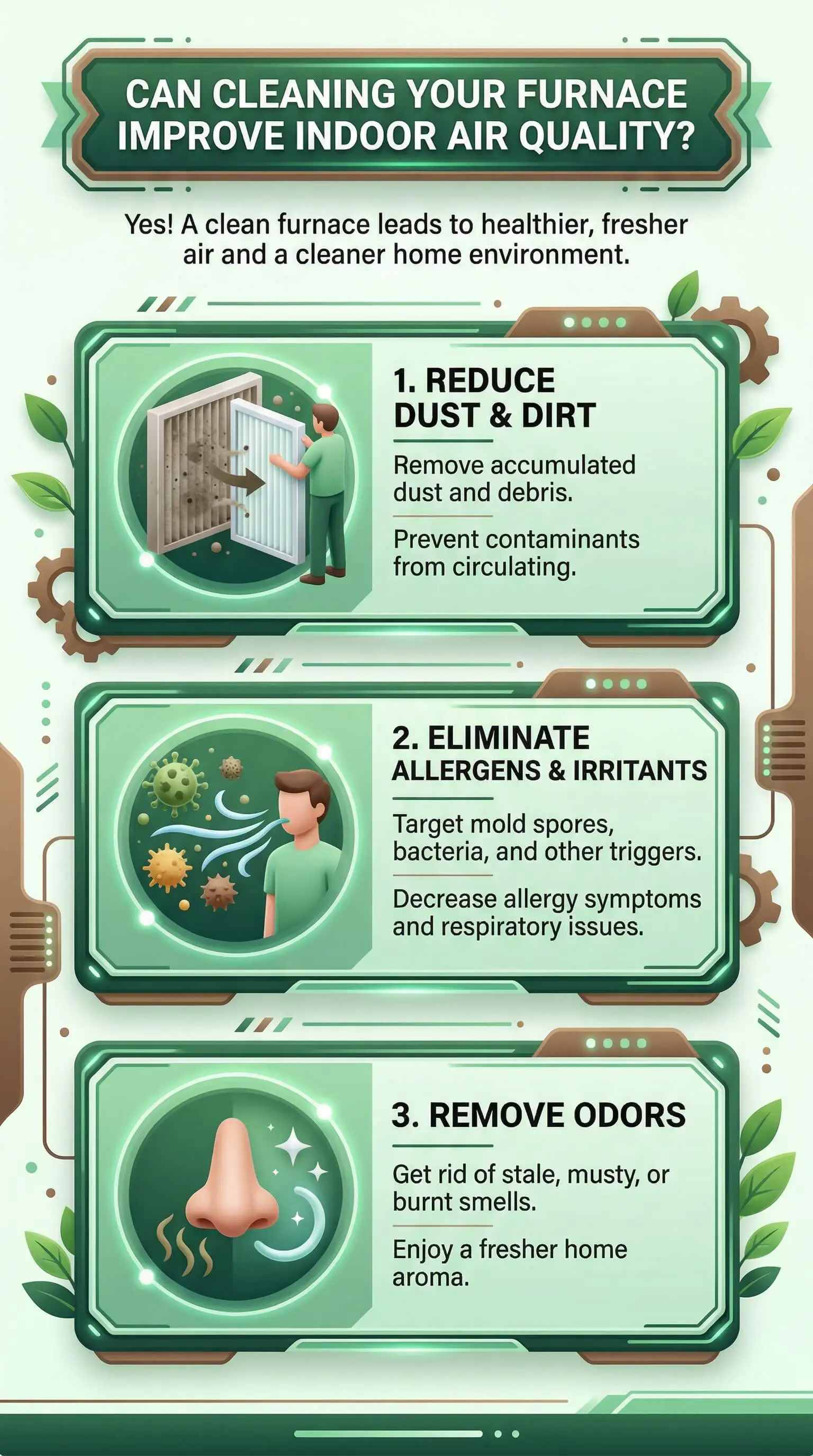
FAQ on How to Clean a Furnace
Q: How often should I clean my furnace?
A: Once a year. Schedule it in late summer or early fall — before the heating season begins. After serving more than two million households, one pattern holds: homeowners who clean annually before the first cold snap have fewer emergency calls, lower energy bills, and fewer air quality complaints. Some households need more frequent attention:
Homes with pets — internal debris accumulates faster than most homeowners realize
Households with allergy or asthma sufferers — particulate levels carry a greater health impact
Homes after recent renovation — internal particulate load increases dramatically
Older homes with deteriorating ductwork — debris enters the system from multiple points
Q: Can I clean my furnace myself or do I need a professional?
A: Both — but they cover different ground.
What homeowners can handle:
Replacing the air filter on schedule
Vacuuming visible dust around the furnace exterior
Keeping the area surrounding the furnace clear
What requires a professional:
Blower assembly cleaning
Burner compartment inspection and cleaning
Heat exchanger inspection
Flue and venting system check
In our experience, these are the components that most directly determine indoor air quality — and the ones most likely to be missed in a DIY approach. Getting them wrong does not just leave the job unfinished. It leaves serious safety issues undetected.
Q: What are the signs that my furnace needs cleaning?
A: A dirty furnace rarely announces itself directly. It shows up in symptoms homeowners attribute to something else. Watch for:
Dust reappearing throughout the home within days of cleaning
Headaches or flu-like symptoms that improve when you leave the house
Yellow or flickering burner flames instead of a steady blue
Reduced airflow from vents with no thermostat changes
Energy bills climbing without a change in usage
A furnace not professionally cleaned in more than 12 months
Q: Which furnace components should be cleaned to improve indoor air quality?
A: Not all furnace cleaning tasks contribute equally to air quality. The components that matter most:
Blower and blower wheel — accumulated particles recirculate through every heating cycle
Burner assembly — dirty burners produce incomplete combustion and introduce byproducts into circulated air
Heat exchanger — even small cracks create a direct pathway for combustion gases into your air supply
Air filter housing — an improperly seated filter bypasses its own function entirely
Flue and venting system — blockages trap combustion gases inside rather than exhausting them safely
Q: Does cleaning a furnace actually make a measurable difference to indoor air quality?
A: Yes — and more significantly than most homeowners expect. Across more than two million households, one observation holds consistently: indoor air quality problems rarely have a single cause, but a poorly maintained furnace is almost always part of the picture. A professionally cleaned furnace delivers four compounding improvements:
Removes internal buildup that recirculates contaminants with every heating cycle
Restores proper airflow so the system operates at designed efficiency
Reduces combustion byproduct risk at the heat exchanger and burner level
Allows a quality air filter to perform the way it was designed to
The improvement shows up gradually — less dust, fewer symptoms, more consistent comfort. Most homeowners only make the connection after the cleaning. That is exactly why annual maintenance needs to be a standing commitment, not a reactive one.
Clean Your Furnace, Breathe Better Air
If cleaning your furnace can improve your indoor air quality, the right filter is what keeps it that way — and Filterbuy makes it easy to find the exact filter your system needs, delivered directly to your door. Shop Filterbuy air filters today and take the next step toward cleaner, healthier air for your family.