Most homeowners do exactly what they should — they change filters, wipe down vents, and keep the area around the unit clear. After serving over two million households, we know that kind of routine care makes a real difference. But in our experience, the issues that quietly drain efficiency, shorten equipment life, and compromise indoor air quality are almost never in the places a homeowner can safely reach.
Professional furnace cleaning goes layers deeper — into the heat exchanger, blower motor assembly, burners, flue, and the sensors that govern how your system actually runs. These are the components that accumulate the buildup and stress no DIY effort can address without specialized tools and certified training.
This page breaks down exactly what a professional cleaning covers, why each step matters, and what gets left undone when those steps are skipped, so you know precisely how to clean a furnace, what thorough furnace care looks like, and how it helps protect your system.
TL;DR Quick Answers
How to Clean a Furnace
Furnace cleaning has two layers — what homeowners can do and what only a certified technician should handle.
What you can safely do yourself:
Replace the air filter every 90 days
Vacuum accessible return vents and registers
Wipe down the exterior cabinet
Clear debris from around the unit
Check thermostat settings and basic airflow
What requires a professional:
Heat exchanger inspection and carbon deposit removal
Burner assembly cleaning
Blower motor and wheel cleaning
Flue and venting inspection
Flame sensor and ignition system cleaning
Safety control and limit switch testing
After serving over two million households, our experience is consistent: DIY maintenance supports system performance between visits — it does not replace what a certified technician finds and corrects inside the unit. Schedule professional furnace cleaning once a year, ideally before the heating season begins. The components that cause the most damage and the greatest safety risk are the ones homeowners never see.
Top Takeaways
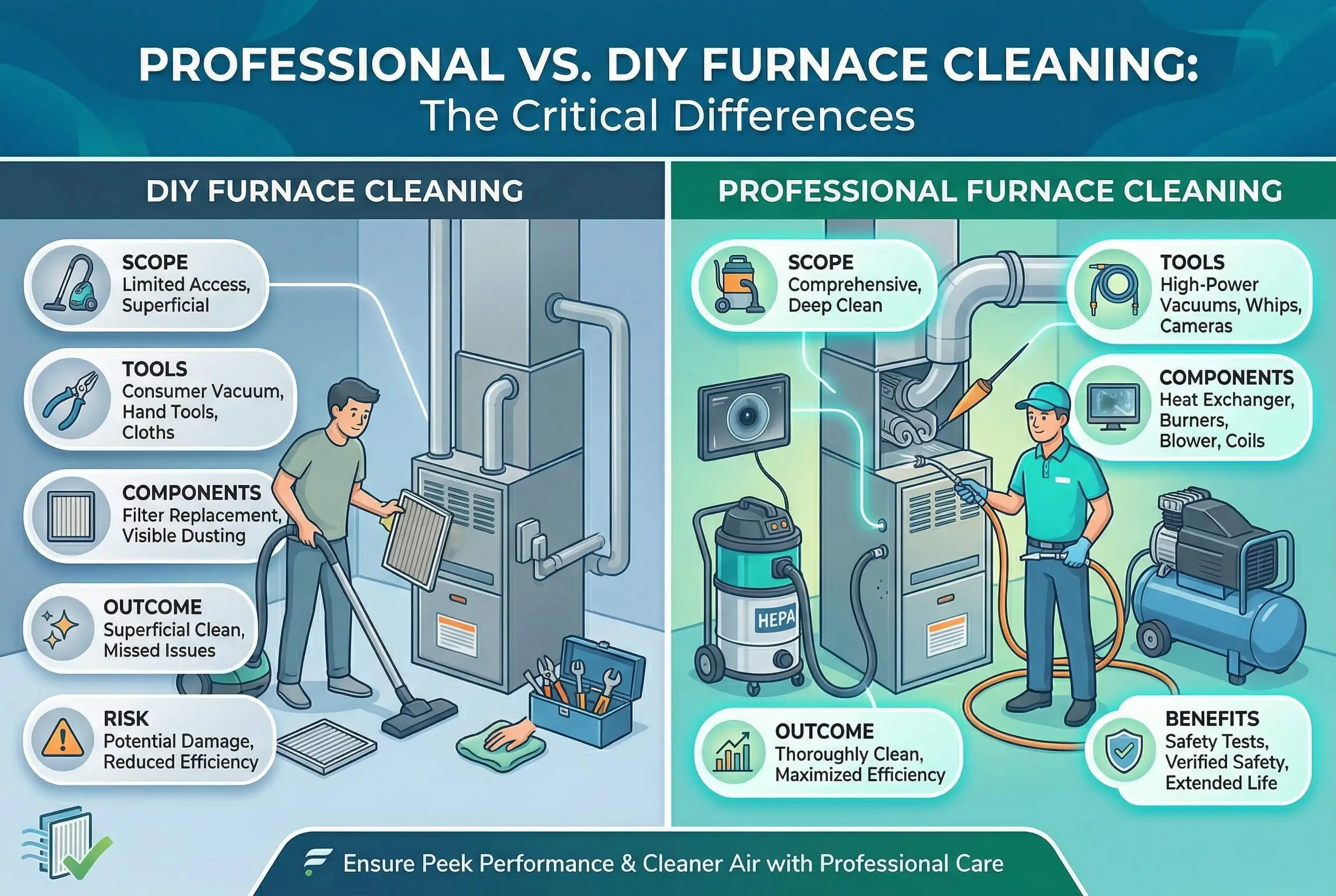
What DIY Furnace Cleaning Covers
Filter replacement, vent wiping, and exterior cleaning
Clearing debris from around the unit
Basic thermostat and airflow checks
These steps support performance — they do not replace professional service
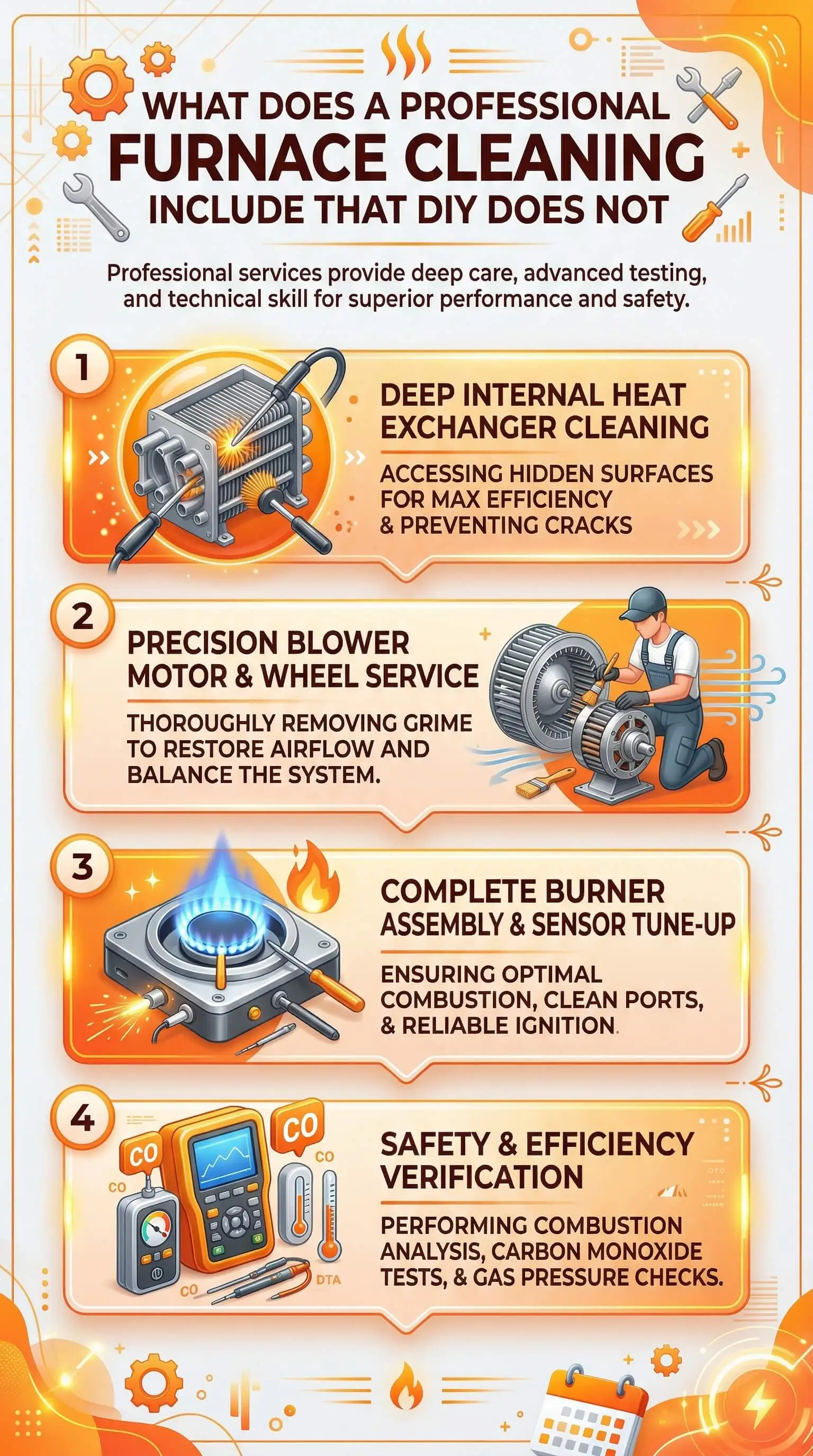
What Professional Furnace Cleaning Covers That DIY Does Not
Heat exchanger inspection and carbon deposit removal
Burner assembly cleaning for proper, efficient combustion
Blower motor and wheel cleaning to restore airflow balance
Flue and venting inspection to prevent carbon monoxide backdraft
Flame sensor cleaning to eliminate short-cycling
Condensate drain clearing on high-efficiency units
Safety control and limit switch testing under operating conditions
What the Data Says
Space heating accounts for 42% of all residential energy use — U.S. EIA
More than 200 Americans die annually from CO linked to malfunctioning fuel-burning appliances — CPSC
Heating systems account for 35% of all consumer product-related CO deaths — CPSC
What It Means for Your Home
A dirty furnace costs more to run on every cycle
The components that fail quietly are the ones homeowners cannot see or safely reach
Annual professional cleaning is the only reliable way to detect venting failures, heat exchanger damage, and combustion problems before they become emergencies
Routine DIY care and annual professional service work together — one does not replace the other
What a DIY Furnace Cleaning Actually Covers
DIY furnace maintenance is worth doing — and we always encourage homeowners to stay engaged with their systems. A typical DIY cleaning includes:
Replacing the air filter
Vacuuming accessible return vents and registers
Wiping down the exterior cabinet
Clearing debris from around the unit
Checking the thermostat and basic airflow
These steps support system performance between professional visits, especially when using the best furnace filters. What they cannot do is reach the internal components where real efficiency loss, equipment stress, and safety risks actually develop.
What a Professional Furnace Cleaning Includes
A certified technician works through a structured cleaning process that covers every functional zone of your furnace — not just the surfaces.
Heat Exchanger Inspection and Cleaning
The heat exchanger is the most critical — and most overlooked — component in your furnace. It separates combustion gases from the air circulating through your home. In our experience, cracked or coated heat exchangers are one of the most common sources of carbon monoxide risk that homeowners never know exists. A professional cleans away carbon deposits and inspects for cracks that no visual check from the outside can detect.
Burner Assembly Cleaning
Dirty burners produce uneven, inefficient flames that force your furnace to work harder to reach temperature. Technicians remove, clean, and inspect each burner to restore proper combustion — reducing fuel consumption and extending the life of the heat exchanger above it.
Blower Motor and Wheel Cleaning
The blower motor moves conditioned air through every room in your home. When the blower wheel accumulates dust and debris, it loses balance and efficiency — increasing energy draw and placing unnecessary strain on the motor bearings. Cleaning the blower assembly is one of the highest-impact steps in a professional service, and it requires full disassembly that most homeowners are not equipped to perform safely.
Flue and Venting Inspection
The flue carries combustion byproducts out of your home. Blockages, corrosion, or improper draft in the venting system can redirect carbon monoxide back into your living space. A technician clears obstructions, checks connections, and verifies that exhaust gases are moving in the right direction.
Flame Sensor and Ignition System Cleaning
A coated flame sensor is one of the leading causes of furnaces that short-cycle — shutting off shortly after ignition because the sensor cannot confirm a flame is present, which can sometimes lead to concerns about HVAC replacement. Technicians clean the sensor rod and inspect the ignition components to restore reliable startup performance.
Condensate Drain Cleaning (High-Efficiency Units)
High-efficiency furnaces produce condensation as part of the combustion process. When the condensate drain clogs, it can trigger a system shutdown or allow moisture to accumulate inside the unit. Technicians flush and clear the drain line to keep the system running without interruption.
Safety Controls and Limit Switch Testing
Every furnace has safety controls designed to shut the system down if temperatures exceed safe thresholds. A professional tests these controls under operating conditions to confirm they respond correctly — something that cannot be verified without running the system through a proper diagnostic sequence.
Why the Difference Matters
The gap between a DIY cleaning and a professional cleaning is not about effort — it is about access, tools, and trained eyes on components most homeowners will never see. In our experience servicing furnaces across thousands of homes, the systems that run longest, consume the least energy, and maintain the best air quality are the ones that receive consistent professional attention alongside good homeowner habits.
A professional cleaning does not replace what you do between visits, and MERV 13 air filters help support that ongoing care. It reaches the places you cannot — and addresses the problems that do not announce themselves until they become expensive.
"Most homeowners are surprised when I show them what's inside their furnace after a few seasons without professional service. The burners are caked, the blower wheel is out of balance, and the flame sensor can barely do its job. None of that shows up on the outside of the unit — and none of it gets addressed with a filter swap and a vacuum. After servicing furnaces in thousands of homes, I can tell you that the systems we see break down early almost always share one thing in common: they were cleaned on the surface but never touched underneath. Professional cleaning is not a luxury add-on. It is the maintenance layer that actually protects the investment you have already made."
Essential Resources
After manufacturing air filters for over a decade and serving more than two million households, we know that the homeowners who make the best decisions about their furnaces and furnace filters are the ones who go straight to the source. The resources below come from federal agencies with direct authority over home heating safety, energy efficiency, and indoor air quality. Each one gives you the kind of grounded, government-backed information that helps you understand not just how to clean a furnace — but why each step exists and what you are actually protecting when you do it right.
What the EPA Says About Cleaning Your Home's Heating System The EPA recommends having fuel-burning furnaces inspected and serviced before every heating season — not as a suggestion, but as a carbon monoxide protection measure. This resource helps homeowners understand the difference between surface-level maintenance and the kind of professional service that addresses real health and safety risk. https://www.epa.gov/indoor-air-quality-iaq/should-you-have-air-ducts-your-home-cleaned
How Carbon Monoxide Risk Connects Directly to Furnace Maintenance Most homeowners cannot see, smell, or detect a carbon monoxide problem until it becomes dangerous — and in our experience, that invisible risk is exactly what makes professional furnace cleaning so important. The EPA's indoor air quality guidance identifies neglected furnaces as a primary source of CO exposure in the home and explains what proper maintenance actually prevents. https://www.epa.gov/indoor-air-quality-iaq/carbon-monoxides-impact-indoor-air-quality
The Official ENERGY STAR Maintenance Checklist for Heating Systems This government-backed checklist lays out exactly what a qualified HVAC contractor should inspect, clean, and verify during an annual furnace service — from blower components to condensate drains to safety controls. Use it as a benchmark for what a thorough professional cleaning should cover, and what to ask your technician about. https://www.energystar.gov/saveathome/heating-cooling/maintenance-checklist
What ENERGY STAR Certification Means for Your Furnace's Long-Term Performance A certified furnace is only as efficient as the maintenance that keeps it running at spec. ENERGY STAR's furnace resource explains how certified systems perform and why consistent professional service is what preserves those efficiency ratings over the life of the equipment. https://www.energystar.gov/products/furnaces
The Department of Energy's Complete Guide to Furnaces and Boilers One of the most comprehensive government references available on residential furnace care. The DOE's Energy Saver resource covers efficiency ratings, venting requirements, sealed combustion systems, and the specific maintenance tasks that must be handled by a certified heating professional — not a DIY checklist. https://www.energy.gov/energysaver/furnaces-and-boilers
Why the CPSC Recommends Annual Professional Furnace Inspections The U.S. Consumer Product Safety Commission does not leave this open to interpretation — it explicitly urges homeowners to schedule yearly professional inspections of all fuel-burning heating systems. This resource outlines the safety risks that go undetected without certified service, and it comes from the federal agency responsible for protecting consumers from product-related injury and death. https://www.cpsc.gov/Newsroom/News-Releases/2002/CPSC-Urges-Seasonal-Furnace-Inspection-to-Prevent-CO-Poisonings
The CPSC Carbon Monoxide Fact Sheet Every Furnace Owner Should Read On average, more than 200 people in the United States die every year from carbon monoxide produced by malfunctioning fuel-burning appliances — and furnaces are among the top contributors. This CPSC fact sheet details how CO exposure happens, what warning signs to watch for, and why annual professional maintenance is the most effective line of defense available to homeowners. https://www.cpsc.gov/safety-education/safety-guides/carbon-monoxide/carbon-monoxide-fact-sheet
Supporting Statistics
The numbers behind professional furnace care represent real dollars spent, real energy wasted, and real families put at risk by heating systems that were never properly serviced.
Space Heating Accounts for 42% of All Residential Energy Use in the United States
According to the U.S. Energy Information Administration's Residential Energy Consumption Survey, space heating is the single largest energy end use in American homes — and an undermaintained furnace makes it more expensive than it needs to be.
Space heating accounts for 42% of all residential energy consumption
The average household spends $519 annually on space heating
A dirty furnace runs harder on every cycle, for an entire heating season
That inefficiency accumulates quietly in higher monthly bills — not in one dramatic event
https://www.eia.gov/pressroom/releases/press535.php
More Than 200 Americans Die Each Year from Carbon Monoxide Produced by Malfunctioning Fuel-Burning Appliances
The U.S. Consumer Product Safety Commission identifies malfunctioning furnaces among the primary sources of residential carbon monoxide exposure. Carbon monoxide is colorless and odorless. There is no DIY method for confirming a furnace is not producing it at dangerous levels.
More than 200 people die annually from CO produced by non-automotive consumer products
Malfunctioning fuel-burning appliances — including furnaces — are listed among the primary sources
The CPSC recommends annual professional inspection of all fuel-burning heating systems
Inspectors must verify chimneys, flues, and connections for blockages, corrosion, and disconnections
https://www.cpsc.gov/safety-education/safety-guides/carbon-monoxide/carbon-monoxide-fact-sheet
Heating Systems Account for 35% of All Consumer Product-Related Carbon Monoxide Deaths
CPSC data identifies heating systems as the second leading source of consumer product-related CO fatalities — behind only portable generators. These are not outlier events. They are the predictable result of systems that go uninspected.
Heating systems account for approximately 35% of all consumer product-related CO deaths
That represents an average of 63 deaths per year attributed to heating equipment
The same CPSC data recorded an average of 32,900 heating-related residential fires per year
Professional cleaning and inspection is the only reliable method for detecting venting failures, dangerous buildup, and component deterioration before they become emergencies
Final Thoughts
A furnace does its most important work invisibly — burning fuel, moving air, and managing combustion byproducts inside sealed components most homeowners will never see. That is precisely where the difference between DIY maintenance and professional cleaning matters most.
What Routine DIY Care Actually Accomplishes
Surface-level maintenance is worth doing. In our experience serving over two million households, homeowners who stay engaged between professional visits consistently see better outcomes.
Changing filters regularly improves airflow and reduces system strain
Clearing debris around the unit prevents circulation problems
Routine attention extends the life of accessible components
DIY maintenance is the foundation — professional service builds on top of it
What Only a Professional Can Actually Find
The components driving real risk and real inefficiency are the ones no homeowner can safely access or accurately evaluate.
A coated heat exchanger does not announce itself
A failing flame sensor does not send a warning
A compromised flue does not look different from the outside
These problems accumulate over seasons — silently reducing efficiency and creating safety conditions that only become visible when something goes wrong
Our Take
Professional furnace cleaning is not a premium service reserved for worst-case scenarios. It is the maintenance layer that helps pleated air filters perform at their best, supporting cleaner air, stronger airflow, and better overall care for your home.
The data from the EPA, CPSC, and Department of Energy supports this clearly. But the numbers alone do not capture what it looks like to open a furnace that has gone years without professional service:
Burners caked with buildup
A flame sensor too coated to function reliably
A blower wheel so far out of balance it is straining the motor on every cycle
Every time, the homeowner had no idea.
That is the invisible problem professional cleaning exists to solve. The homes that get it right are the ones that never have to find out what would have happened if they had not.
FAQ on How to Clean a Furnace
Q: What does a professional furnace cleaning include that DIY does not?
A: DIY covers what you can reach. Professional cleaning covers what you cannot.
DIY: filter replacement, vent cleaning, exterior wiping, debris removal
Professional: heat exchanger, burner assembly, blower wheel, flame sensor, flue, and safety controls
After servicing furnaces across thousands of homes, our technicians find the same pattern every time. The components that determine how safely and efficiently a furnace runs are the ones no homeowner can safely access — and the ones where buildup and wear quietly accumulate season after season.
Q: How often should a furnace be professionally cleaned?
A: Once a year — ideally in late summer or early fall before the heating season begins.
Homes with pets or smokers may need more frequent service
Recent renovations increase dust and debris load on the system
Family members with asthma or allergies benefit from more frequent professional attention
In our experience serving over two million households, systems with consistent annual service run more efficiently, last longer, and generate fewer emergency calls than those serviced only when something breaks.
Q: Is it safe to clean a furnace yourself?
A: Some of it — and we encourage homeowners to stay engaged with their systems.
Safe for DIY:
Filter replacement
Exterior cabinet cleaning
Clearing debris around the unit
Vacuuming accessible vents and registers
Not safe for DIY:
Burners and combustion components
Heat exchanger inspection and cleaning
Flame sensor servicing
Blower motor and wheel disassembly
Flue and venting evaluation
These internal components involve combustion, gas connections, and carbon monoxide risk that require specialized tools and certified training.
Q: What are the signs that a furnace needs professional cleaning?
A: The most common warning signs our technicians encounter in the field:
Rising energy bills without a change in usage habits
Uneven heating across rooms or floors
Short-cycling — the furnace starts and shuts off in quick succession
Unusual odors during startup or operation
Yellow or orange flames instead of blue on a gas burner
Excessive dust circulating through the home
Yellow flames and unusual odors should never wait for a scheduled visit. Both can indicate active carbon monoxide risk. Call a certified technician immediately.
Q: How does a dirty furnace affect indoor air quality?
A: Every cycle pushes air through whatever has accumulated inside the system.
A buildup-coated blower wheel restricts airflow and reduces circulation efficiency
A compromised heat exchanger can allow combustion gases to mix with circulating air
Dirty internal components increase particulate concentration in the air your family breathes daily
After manufacturing air filters for over a decade and serving more than two million households, we have seen consistently that professionally maintained furnaces produce measurably better indoor air quality than those relying on surface-level care alone. Clean filtration helps — but it cannot compensate for a furnace that has never been cleaned from the inside out.
Ready to Go Beyond What DIY Can Reach?
Schedule a professional furnace cleaning with Filterbuy HVAC Solutions and let our certified technicians handle the components that matter most — the ones you cannot see, safely access, or evaluate without specialized tools and training. Book your appointment today and get the peace of mind that comes with knowing your furnace has been cleaned from the inside out.