So is paying a professional worth it? For most drivers with glove box access, no. RepairPal's cost estimator puts the national average at $91 to $114, with $45 to $66 of that going to labor, while a good replacement filter on its own commonly runs $15 to $50. Five situations do make the shop fee worth paying, though.
Don't take the air inside your car for granted. Your cabin air filter, also called a pollen filter, cleans the outside air your car pulls in before it reaches the vents, and almost everything it catches is too small to see.
TL;DR Quick Answers
cabin air filter replacement
Cabin air filter replacement means swapping the pleated filter that cleans outside air before it reaches your vents. Most cars need one every 12,000 to 15,000 miles, or about once a year. Most glove box filters take 10 to 20 minutes and no tools. Shops average $91 to $114, and about half of that is labor.
Look first: Pull the filter before paying anyone. Grey, matted media or a musty smell means it’s due.
Do it yourself: It’s the smart call when the filter sits behind the glove box.
Pay a professional: It’s worth it for cowl or under-dash housings, odors that outlast a fresh filter, or physical limits.
Spend on the filter, not the labor: In CDC-indexed testing, high-efficiency cabin filters cut in-cabin ultrafine particles by 93 percent, against about 50 percent for factory filters.
Match the fit: Use your vehicle’s part number so no unfiltered air slips around the edges.
Top Takeaways
Most drivers can skip the labor charge. A glove box filter swap takes 10 to 20 minutes and no tools.
Shops average $91 to $114 for the job, and roughly half of that is labor.
Pay a professional when access is hard, the shop bundles it with other work, you need records, a smell won't quit, or the job isn't safe for you.
The filter media matters most. High-efficiency filters cut in-cabin ultrafine particles far more than standard factory filters.
Replace it every 12,000 to 15,000 miles or once a year, and sooner if you drive through dust, smoke, or heavy traffic.
What You Pay For When a Shop Replaces Your Cabin Air Filter
About half that bill is labor. Shops charge by book time, which means a two-minute swap behind the glove box still carries a full labor line. Dealers tend to price the highest. Quick-lube chains like to pitch it as an oil change add-on.
Before you say yes, ask for the quote split into part and labor. You'll spot the problem right away if the filter on the estimate costs twice what the same part sells for elsewhere, whether it's a cabin air filter or MERV 8 pleated furnace air filters, because then you're paying markup on both lines.
Five Situations Where Paying a Professional Makes Sense
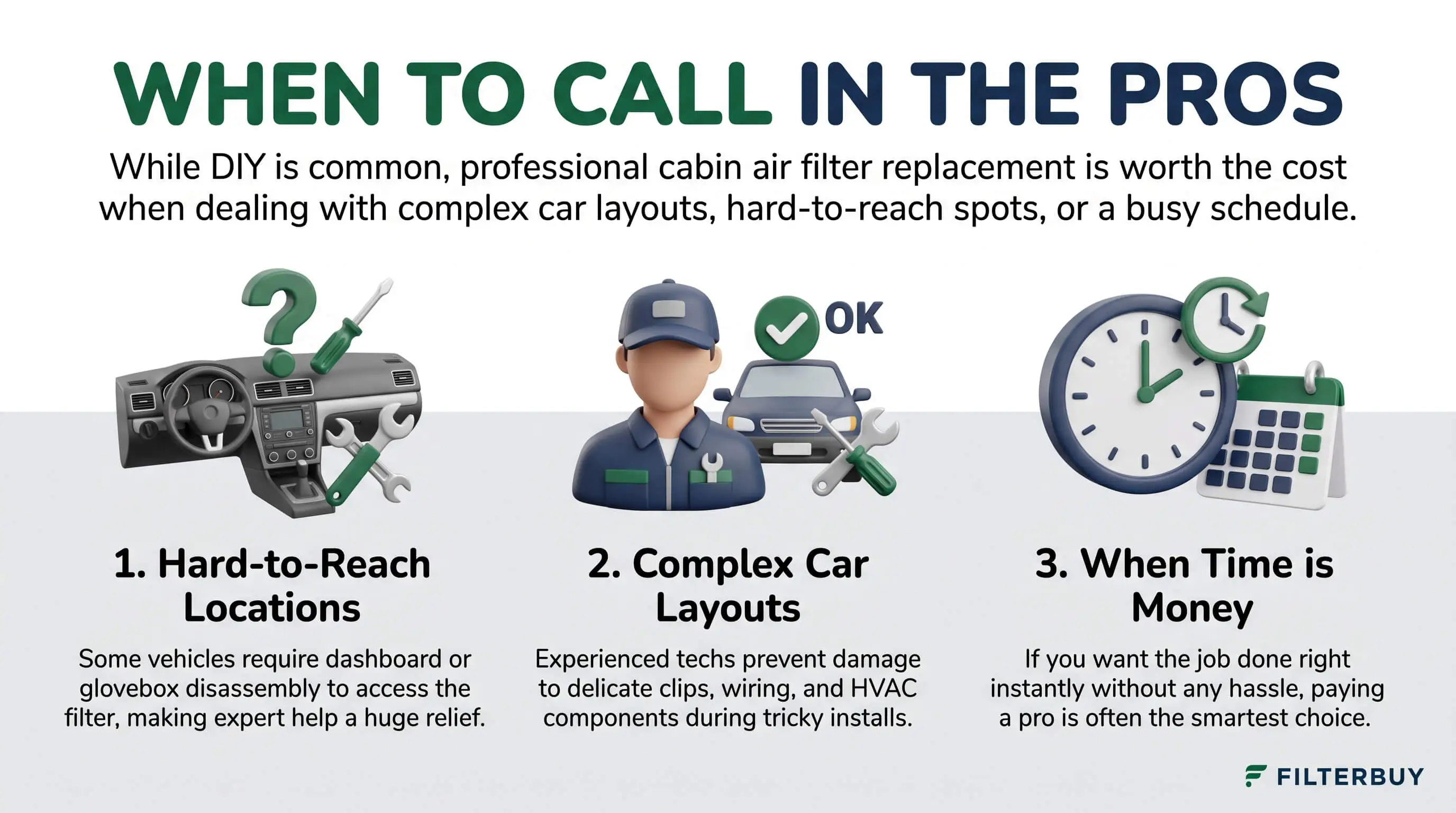
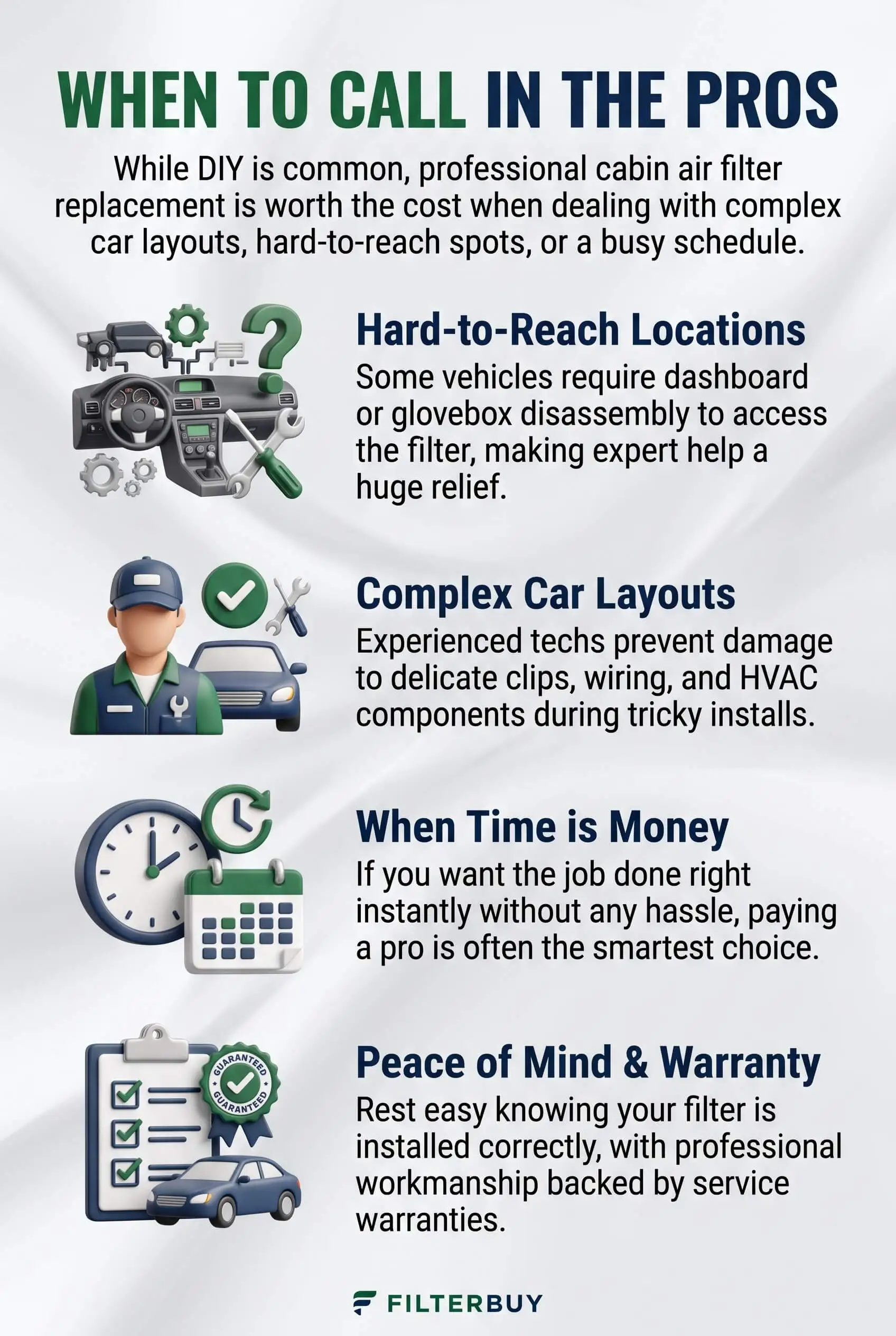
The filter hides behind the dash or under the cowl. On some vehicles you'd have to pull the wiper arms or trim panels to reach a housing under the windshield cowl. Others tuck it up under the dash, where brittle plastic clips snap easily.
The shop bundles it into service you already need. When a shop waives or trims the labor charge during scheduled maintenance, you're only paying the part markup.
You want a stamped service record. Lease returns and some private buyers like seeing every maintenance item on a shop invoice.
A musty smell points past the filter. A new filter won't clear mold growing on the evaporator core. If the smell hangs around after a fresh filter goes in, book an evaporator cleaning with a technician.
Mobility, space, or tools make the job unsafe. Not everyone can kneel in a footwell and work overhead, and that alone justifies the fee.
When DIY Cabin Air Filter Replacement Is the Smarter Call
If your owner's manual puts the filter behind the glove box, you're looking at 10 to 20 minutes and no tools. Little effort, big impact.
Empty the glove box and release its side stops so it swings down.
Unclip the filter access cover.
Slide the old filter out and note which way the airflow arrow points.
Insert the new filter with the arrow facing the same direction.
Snap the cover back on and reattach the glove box.
Get the fit right before you open the glove box, since that's where most DIY swaps go wrong. Pick a replacement cabin air filter matched to your vehicle's part number so it seals tight against the housing and unfiltered air has no gap to slip through.
Filter Quality Matters More Than Who Installs It
A shop can install a basic filter perfectly and you'll still get basic filtration. The media does the work. You'll never see the ultrafine particles drifting in from the car ahead, yet high-efficiency cabin filters catch far more of them than the standard filters many cars leave the factory with.
Pleated media traps road dust and pollen.
An activated carbon layer soaks up exhaust odors and some gases.
Fit counts as much as the rating, because air always takes the easiest path around a loose filter.
Shop for home HVAC filters and this will sound familiar. The same logic behind how MERV ratings work for home filters applies in your car. Finer media catches smaller particles but adds airflow resistance, so choose a filter built for your vehicle's blower over the densest one on the shelf.
A Five-Minute Way to Decide
Find your filter's location in the owner's manual.
Pull the filter and take a look. Grey, matted media, trapped leaves, or a musty smell all mean it's due.
Ask the shop to split the quote into part and labor.
When access is easy and the labor charge tops the price of the filter itself, do it yourself.
When any of the five situations above applies, the professional fee is money well spent.
"I've pulled cabin filters on hundreds of vehicles, and the most common thing I see is drivers paying for a change they didn't need yet, with highway commuters bringing in filters that are barely grey at 10,000 miles while cars parked under trees or driven on gravel clog theirs in half that time. A clogged filter starves the blower long before you notice a smell, so I tell people to pull it and look first, then put their money into better media instead of labor."
Essential Resources
Each source below comes from a government agency or established nonprofit. Use them to check a quote or plan your own swap.
Car Care Council: Changing Your Cabin Air Filter. The nonprofit covers replacement intervals, earlier changes for smoke or dust, and where the access panel sits.
FTC: Auto Warranties and Auto Service Contracts. The FTC confirms you don't need the dealer for routine maintenance to keep a warranty in effect.
EPA: What Is a MERV Rating?. EPA explains how efficiency ratings describe particle capture, which helps when a cabin filter box lists a MERV value.
American Lung Association: Highway Air Pollution and Your Health. The association explains tailpipe pollution risks and tells drivers to keep windows up and recirculate air.
National Jewish Health: Reducing Pollen Exposure. This respiratory hospital recommends keeping car windows up and running the air conditioning during pollen season.
Oregon Smoke Information: Safeguarding Yourself From Wildfire Smoke on the Road. Oregon's state agencies advise closing the outside air intake and switching to recirculation in smoke.
NHTSA: Summer Road Safety Tips. NHTSA reminds drivers to follow the manufacturer's service schedule and check for open recalls by VIN.
Supporting Statistics
Every study below points the same way, toward the filter media itself.
High-Efficiency Cabin Filters Cut Ultrafine Particles by 93 Percent
In tests on 12 passenger vehicles, high-efficiency cabin air filters averaged a 93 percent drop in in-cabin ultrafine particles.
The original equipment filters averaged about 50 percent.
CDC Stacks: High-Efficiency Cabin Air Filter Study in Passenger Vehicles
Better Media More Than Doubled Fine Particle Reduction
In a study prepared for the California Air Resources Board, high-efficiency filters cut in-cabin PM2.5 by 66 percent on average.
In-use factory filters managed about 29 percent.
Black carbon followed the same pattern, with 81 percent against 31 percent.
California Air Resources Board: Reducing Air Pollution Exposure in Passenger Vehicles
Cabin Air Filtration Reduced Commuter Exposure by Almost a Third
Health Canada researchers ran a randomized crossover study that followed 48 adults through rush-hour commutes.
Compared with a placebo filter, cabin air filtration lowered PM2.5 by 30 percent, black carbon by 32 percent, and ultrafine particles by 28 percent.
PubMed Central: Health Canada In-Vehicle Cabin Air Filtration Study
Studies show that high-efficiency cabin air filters significantly reduce fine and ultrafine particles inside vehicles, improving air quality without the need for replacing HVAC system components.
Final Thoughts
Here's where I land. If your filter sits behind the glove box, keep the labor money and put part of it toward a better filter. That one choice does more for the air you breathe on your commute than any shop visit will.
I'd hand the job to a professional without a second thought when the housing is buried under the cowl, when a musty smell outlasts a fresh filter, or when a physical limit makes the work risky. In those cases you're paying for expertise you actually need.
The same habit pays off at home. You're the one keeping the air clean for everyone who rides and lives with you, and changing filters on schedule with the right media is how you save money on filter replacement in your house too.
Frequently Asked Questions
Can I replace my cabin air filter myself?
Yes, in most vehicles. When the filter sits behind the glove box, you can usually swap it in 10 to 20 minutes without tools. Check your owner's manual first, because filters under the cowl or dash take more work and may justify a shop visit.
How much do dealerships charge for cabin air filter replacement?
RepairPal's national estimate for professional cabin air filter replacement runs $91 to $114. Dealer quotes can come in above that, depending on your vehicle and local labor rates.
Does replacing the cabin air filter myself affect my warranty?
Not on its own. The FTC says you don't have to use the dealer for routine maintenance to keep your warranty in effect. Hang on to your receipt with the date and mileage.
What happens if I never change my cabin air filter?
Your vents push out less air, the blower works harder, and windows take longer to defog. Meanwhile, more dust, pollen, and odor make it into the cabin.
Is a high-efficiency or carbon cabin filter worth paying more for?
Usually, yes. In the CDC and California Air Resources Board studies above, high-efficiency media used in top air filters removed far more fine and ultrafine particles than standard factory filters, and a carbon layer cut down on exhaust smells. Just pick a filter designed for your vehicle so airflow stays strong.
Make the Right Call on Your Cabin Air Filter Replacement
Check where your cabin air filter sits and what your quote actually covers before you approve that line item. Then spend your money on a filter that fits and filters well, whether you install it yourself or let a shop handle it, just as you would when choosing the right filter for an HVAC replacement.