The outdoor unit hums the way it always does, and the vent above your couch is pushing air about as cool as a summer porch. Nothing sounds wrong. That's exactly what makes an air conditioner not blowing cold air but running so maddening.
Here's something most homeowners miss. A normal sound is good news, and it's also a clue. It usually means power is reaching the compressor and both fans are spinning, so the failure is hiding somewhere you can't hear, in how your system pulls heat out of the house. Some of the fixes take five minutes and a filter in your hand. Others need a licensed technician with a set of gauges.
TL;DR Quick Answers
air conditioner not blowing cold air but running
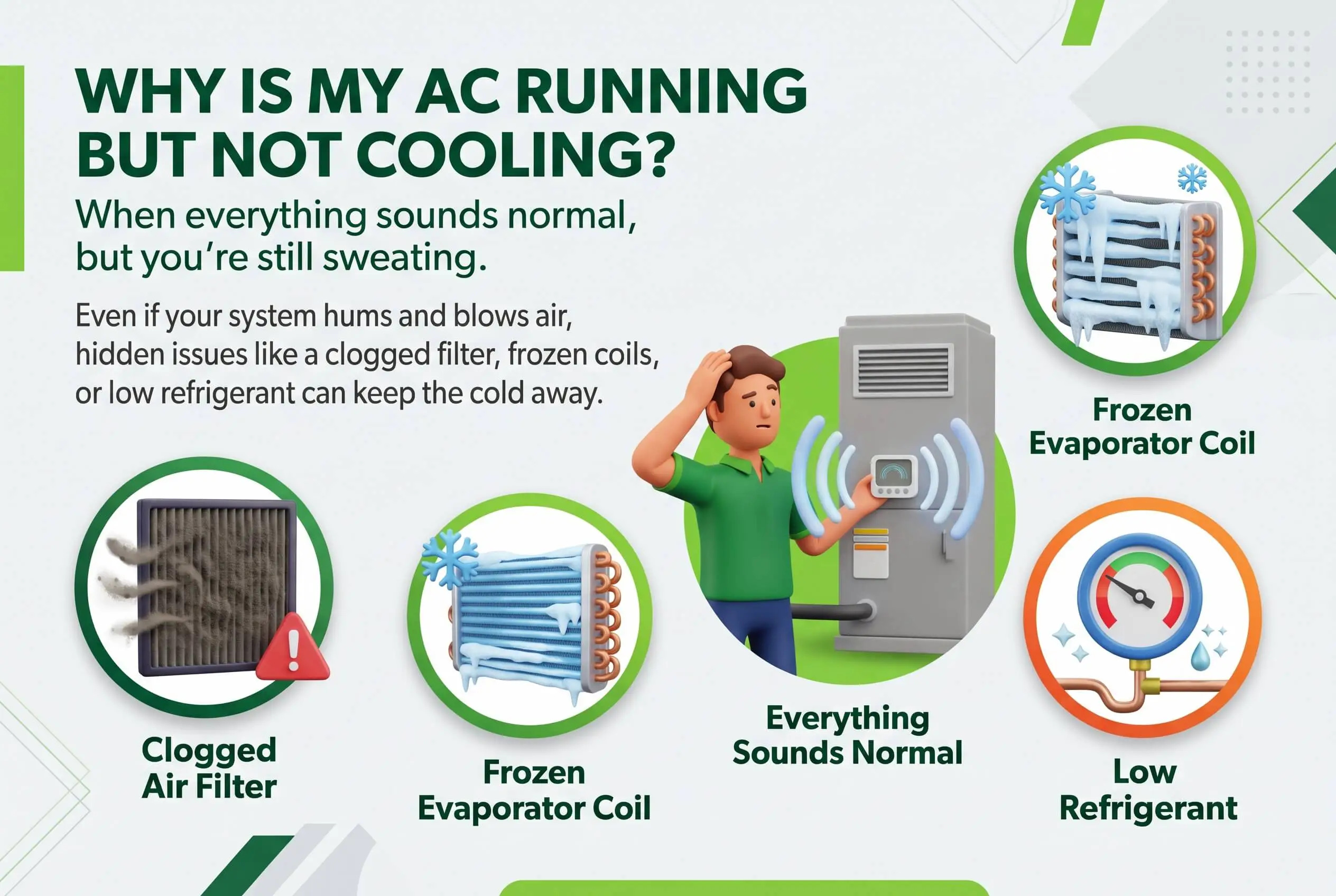
If your AC runs and sounds normal but blows warm air, that steady hum is your best clue. Power is reaching the compressor and fans, so the fault almost always lies in heat transfer, usually a clogged filter, dirty coils, the wrong refrigerant charge, or leaky attic ducts. Start with the free checks.
Thermostat: Set it to Cool with the fan on Auto, not On.
Filter: Hold it up to a light, and replace it if barely any light passes through.
Outdoor coil: With the power off, rinse the fins gently and clear two feet of space around the unit.
Copper line: The larger line should feel cool and sweaty. If it’s warm, suspect a refrigerant problem.
Refrigerant: Leave it to a certified technician. A low charge means a leak, and the system won’t use refrigerant up on its own.
Top Takeaways
A normal sound with warm air almost always points to a heat-transfer problem, not a power or motor failure.
Start with the free fixes. Set the fan to Auto, check the filter, and rinse the outdoor coil.
Leave refrigerant to a certified technician. Charge problems are common and silent.
Leaky attic ducts can lose cold air before it ever reaches your rooms.
Measure your temperature split before you call, so you can describe the problem clearly.
What a "Normal" Sound Actually Tells You
Your air conditioner doesn't get cold. It moves heat. Refrigerant in the indoor evaporator coil soaks up heat from your air and carries it outside to the condenser coil, which releases it while the compressor keeps the loop under pressure. Engineers call it the vapor-compression cycle.
When the compressor hums steadily and both fans turn, the electrical half of that loop is doing its job. That puts the trouble in heat transfer. And heat-transfer problems almost never make a sound.
Odd noises tell a different story. A hum paired with a fan that won't turn usually points to a weak capacitor, while repeated clicking can mean a sticky contactor or a thermostat fault. Hissing near the copper lines is the one I'd take most seriously, since it can mean refrigerant is escaping. If you're hearing any of those, skip the list below and call a technician to assess the problem and recommend repairs or HVAC replacement.
The Quiet Faults Behind Warm Air From a Running AC
The Thermostat Fan Is Set to On
This one catches more people than you'd think. With the fan set to On, the blower never stops, so between cooling cycles it simply circulates room-temperature air that feels warm on your hand. Flip it to Auto and give it one full cycle.
A Clogged Filter Starving the Evaporator Coil
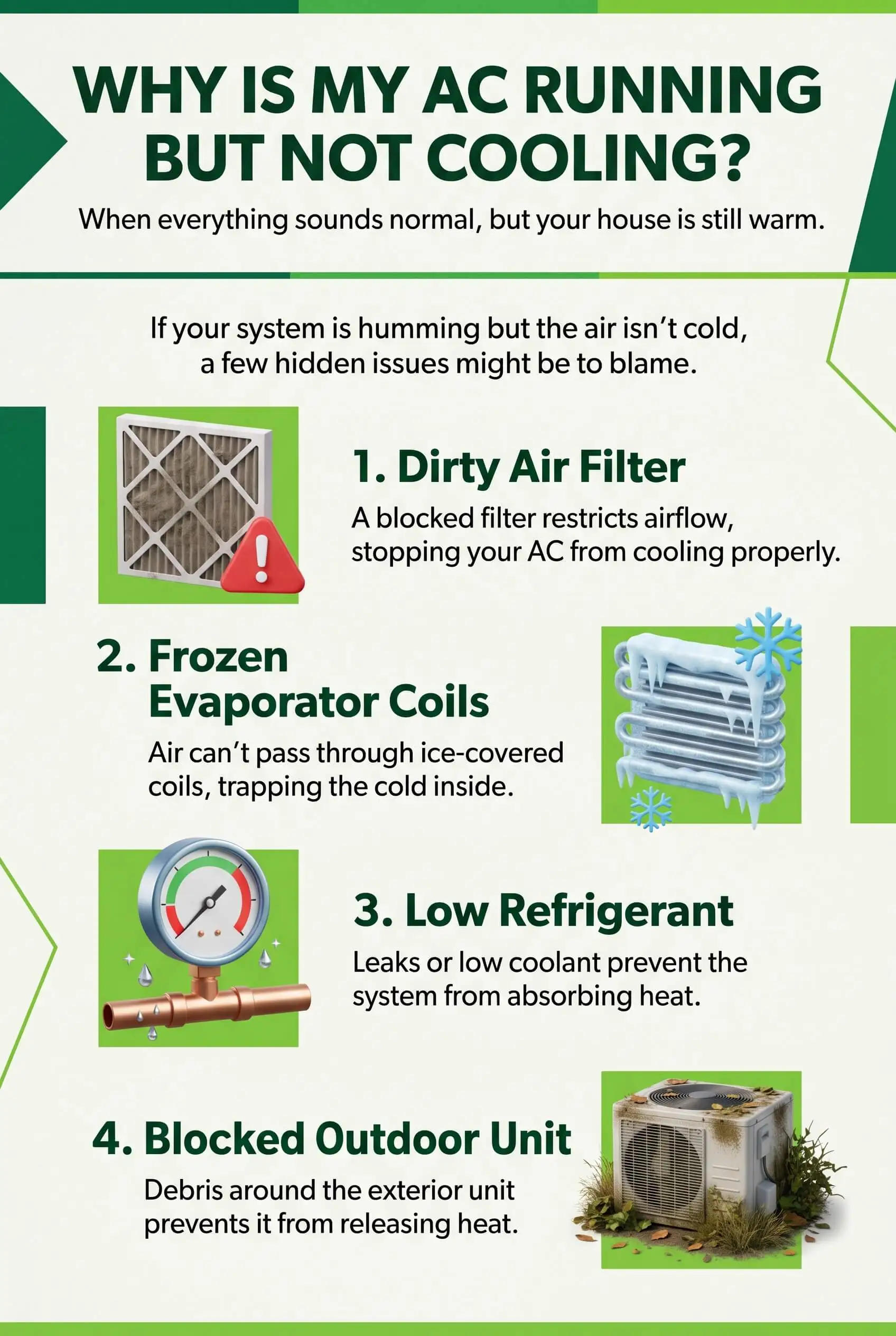
A loaded filter cuts off the warm air your indoor coil needs to stay above freezing. Once that coil freezes, the frost acts like a wall, and very little heat gets through. The fans keep spinning and the compressor keeps humming while the house gets warmer.
A filter that's too restrictive for your system can cause the same trouble, even brand new. In a muggy climate, read up on MERV 13 filter performance in high humidity before you trade up.
Pro Tip: Hold the old filter up to a lamp. If you can barely see light through it, you've probably found your problem.
Dirty Condenser or Evaporator Coils
Think of dirt on a coil as a winter coat in July. Grass clippings and dryer lint pack the outdoor fins until the heat has nowhere to go. With the power off at the disconnect, rinse the fins gently from the inside out with a garden hose, and keep two feet of clear space around the unit. Leave the indoor coil to a technician.
Incorrect Refrigerant Charge or a Slow Leak
Refrigerant isn't fuel, and your system doesn't burn through it. If the level is low, either it leaked out or the system was never charged correctly. Field measurements of 4,168 air conditioners found that more than seven in ten had the wrong charge, and an undercharged system can sound completely healthy while its cooling slips away.
Watch for a larger copper line that feels warm instead of cool. Frost on the lines and cooling that fades week by week point the same way. Federal rules allow only certified technicians to handle refrigerants. If the repair quote makes you wince, here's why refrigerant service costs what it does.
Leaky or Crushed Ductwork
Your AC can make plenty of cold air that never reaches your bedroom. Ducts snaking through a hot attic leak at loose joints and crushed flex runs, so you end up cooling the attic instead of yourself. The giveaway is usually one room that never cools. Seal the gaps you can reach with mastic or foil tape, skip the cloth duct tape, and hand bigger duct repairs to a pro.
Restrictions You Cannot See or Hear
Some faults hide inside the sealed refrigerant system. A clogged filter-drier or a sticking thermostatic expansion valve (TXV) can cut cooling without a single odd noise. So can air that got trapped in the lines during installation or an earlier repair. Finding any of these takes gauges and training.
A System Working Past Its Capacity
Sometimes nothing's broken. On a brutal heat-wave afternoon, a perfectly healthy AC can run nonstop and still finish a few degrees above the setpoint. High humidity and an undersized system make that gap wider. If the house catches up after sunset, that's a capacity limit, not a fault.
Warm Air vs. Weak Air: Which Problem Do You Have?
Hold your palm over a supply register. A strong stream of warm air means the faults above are your short list. Barely any air means a different failure, often a tripped condensate float switch, a blower panel that isn't seated, or a blower motor that's quit. This walkthrough of an AC running but no air coming from the vents covers those checks in order.
A 15-Minute Check Before You Call Anyone
Set the thermostat to Cool with the fan on Auto, a few degrees below the room temperature.
Pull the filter. If it fails the lamp test, replace it.
Head outside, clear debris from the unit, and look for ice on the larger copper line.
Touch that same line near the outdoor unit. Cool and sweating is what you want. Warm suggests a charge problem.
Measure the temperature split. After 15 minutes of runtime, compare thermometer readings at a return grille and the nearest supply register. A healthy split often lands around 15 to 20 degrees Fahrenheit, and a much smaller gap means the system is losing capacity.
Found ice? Switch the thermostat to Fan Only and let it thaw on its own. Don't chip at it.
When to Stop and Call a Technician
Ice comes back after a full thaw and a fresh filter.
You hear hissing or spot oily residue on the refrigerant lines.
The AC breaker trips.
The temperature split stays low with a clean filter and a rinsed coil.
Your next step involves refrigerant.
For the components that usually wear out first, see this rundown of the parts that most often go bad on an AC unit.
"Based on my experience on residential service calls, the systems that fool homeowners most are the quiet ones. Both fans are running, the compressor's humming, and the charge is a pound short because of a pinhole leak at a flare fitting. The sound only proves the motors work. A temperature split and a set of gauges tell you whether that system is actually moving heat."
Essential Resources
AC Running but No Air? Here's How to Find the Problem Fast, for when airflow stops.
EPA Section 608 Technician Certification Requirements, on who can legally handle refrigerants.
High-MERV Filters, Building America Solution Center, on filter resistance and airflow.
ASHRAE Residential IAQ Guideline on High-Efficiency Filters, home filtration guidance.
Field Measurements of New Residential Air Conditioners in Phoenix, Arizona, on faults in brand-new systems.
Laboratory Measurements and Diagnostics of Residential HVAC Faults, on how hidden faults cut efficiency.
Residential HVAC Fault Data: Refrigerant Undercharge and Overcharge, lab research on charge faults.
These resources explain how airflow restrictions, filter resistance, refrigerant issues, and hidden AC faults affect cooling performance, while highlighting the importance of proper diagnostics and professional HVAC system repair in restoring efficiency and reliable home comfort.
Supporting Statistics
Field measurements of 4,168 air conditioners found that 72% had the wrong refrigerant charge and 44% had improper airflow. Source: U.S. Department of Energy, Building America Measure Guideline
In a typical house, about 20 to 30 percent of the air moving through the duct system escapes through leaks, holes, and poorly connected ducts. Source: ENERGY STAR, Duct Sealing
88% of U.S. households use air conditioning, and two-thirds rely on central AC or a central heat pump as their main equipment. Source: U.S. Energy Information Administration
Final Thoughts and Opinion
I'll say it plainly. The normal sound is the most underrated clue in home cooling. Most guides jump straight to a long list of possible failures, but that steady hum crosses half of it off and points you toward airflow, coils, ducts, or refrigerant charge.
Run the free checks yourself, since a fresh filter chosen from the top air filters and a correctly set thermostat fix more of these than people expect. Then stop. Guessing at refrigerant, or letting a struggling system grind away for days, is how a modest repair turns into a compressor replacement. You're the one who notices the early signs in your own home. A certified technician is the one who can measure what's behind them.
Frequently Asked Questions
Can Low Refrigerants Make an AC Run but Not Cool?
Yes. With less refrigerant in the loop, the system can't carry as much heat outside, so it runs normally while the air stays warm. Refrigerant doesn't get used up, which means a low level points to a leak or a bad original charge. Only a certified technician can fix either one.
Should I Turn My AC Off if It Is Not Cooling?
If you see ice on the lines or hear hissing, shut it off. A starved system leans hard on the compressor, and that's the most expensive part to replace. Without either sign, work through the thermostat and filter checks first.
Can a Dirty Filter Stop an AC From Blowing Cold Air?
It sure can. A clogged filter is one of the most common reasons behind an air conditioner not blowing cold air but running, because choked airflow lets the evaporator coil freeze over. Put in a fresh filter and thaw the coil on Fan Only.
Why Is My Outside Unit Running but the House Is Not Cooling?
When the outdoor unit runs normally, the cause usually comes down to refrigerant charge, a dirty indoor coil, or leaky ductwork. Feel the larger copper line. If it's warm instead of cool, a charge problem moves to the top of the list.
How Long Should an AC Run to Cool a House?
A healthy system cycles on and off for most of the day. Running nonstop through a heat wave is normal. Running all evening without ever reaching the setpoint isn't, and that's worth a service call.
Get Your Cool Air Back
That steady hum is pointing you toward a specific fault, and the checks in this guide help you find it fast. Start with the thermostat and pleated furnace filter, and call in a certified technician for anything that touches the refrigerant.


